


NEWS
How to Choose a Industrial Vision Inspection Lenses
author:admin time:2026-3-20 Number of click:367
Industrial Vision Inspection Lenses: Origins, Core Traits, Industry 4.0 Trends and Robotic Integration
1. Introduction: The Birth and Evolution of Industrial Vision Inspection Lenses
Industrial vision inspection lenses are not accidental innovations but targeted optical solutions born from the transformation of modern manufacturing. In the early days of industrialization, manual inspection dominated quality control, which was plagued by low efficiency, high error rates, fatigue-related omissions, and inability to handle micro-scale or high-speed detection tasks. As automated production lines emerged and product precision requirements surged, traditional consumer-grade lenses—designed for daily photography with loose tolerances, high distortion, and poor durability—failed to meet industrial imaging demands.
Driven by the rise of machine vision systems in the late 20th century, industrial vision lenses were developed to address the pain points of industrial imaging: stable imaging, high precision, low distortion, and adaptability to harsh factory environments. Unlike consumer lenses that prioritize aesthetic imaging, industrial vision lenses are engineered for quantitative, repeatable, and high-precision visual data acquisition, laying the foundation for automated defect detection, dimension measurement, positioning, and identification. Today, they have evolved from basic fixed-focus models to high-resolution, large-target, ultra-low-distortion, and intelligent adaptive lenses, becoming the "optical core" of smart manufacturing.
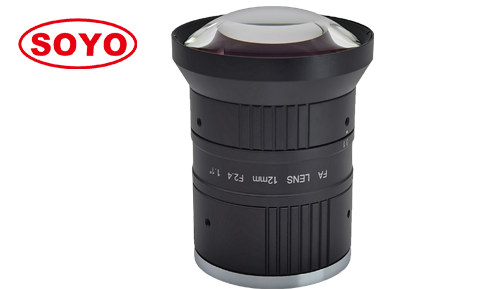
2. Core Parameters and Structural Advantages of Industrial Vision Lenses
The performance of industrial vision inspection lenses is defined by several critical technical indicators, which directly determine detection accuracy, imaging stability, and application compatibility. Below is a detailed analysis of key parameters and their industrial value:
2.1 Pixel and Resolution Matching
Pixels represent the density of imaging sensing points, and lens resolution (measured in line pairs per millimeter, lp/mm) must be highly compatible with camera pixels to avoid pixel waste or blurred imaging. Industrial lenses are designed to support high-pixel sensors (from 1MP to 25MP+), ensuring that every detail of the measured object is captured accurately. A lens with insufficient resolution will cause edge blur and detail loss even with a high-pixel camera, while a high-resolution lens paired with a matching camera achieves micron-level detection, critical for electronics, semiconductors, and precision machinery industries.
2.2 Target Surface Size (Sensor Format Compatibility)
The target surface size refers to the maximum imaging area a lens can cover, typically measured in inches (e.g., 1/1.8", 2/3", 1", 1.2"). A core rule is that the lens target surface must be larger than or equal to the camera sensor size; otherwise, dark corners, vignetting, and incomplete imaging will occur. Large-target lenses support wider field of view (FOV) and higher light intake, enabling full coverage of large workpieces and clearer imaging in low-light conditions. This parameter is pivotal for matching different camera models and expanding application scenarios.
2.3 Aperture Size and Light Control Performance
Aperture (expressed as F-number, e.g., F1.4, F2.8, F16) controls the amount of light entering the lens and affects depth of field (DOF). A smaller F-number means a larger physical aperture, higher light throughput, and suitability for high-speed imaging or weak-light environments; a larger F-number creates a deeper DOF, keeping both foreground and background in focus—ideal for dimension measurement of uneven workpieces. Industrial lenses feature a wide, adjustable aperture range, balancing light intake and DOF to adapt to diverse detection scenarios, unlike consumer lenses with limited aperture adjustability.
2.4 Workmanship and Appearance: Ruggedization for Industrial Scenarios
Workmanship and appearance are not just aesthetic indicators but critical for long-term reliability in harsh industrial environments. Premium industrial lenses adopt:
- All-metal precision machining: Shock-resistant, dust-proof, and oil-proof casings to withstand factory vibration, dust, and oil contamination;
- Multi-layer broadband coating: Reduces light reflection, improves light transmittance, and ensures color consistency and imaging stability;
- Low-distortion optical design: Minimizes geometric distortion (below ±0.2%) for high-precision measurement;
- Standardized interfaces (C-mount/F-mount): Universal compatibility with industrial cameras and easy installation;
- Compact and robust structure: Suitable for narrow installation spaces on production lines and robotic arms.
In contrast, consumer lenses use plastic components, lack environmental resistance, and cannot sustain 24/7 continuous operation in factories.
3. Application Directions of Industrial Vision Inspection Lenses
Industrial vision lenses are widely deployed across manufacturing sectors, enabling non-contact, high-speed, and high-precision visual inspection. Core application areas include:
- Electronics and Semiconductor Industry: Detection of micro-defects (cracks, solder bumps, pin misalignment) on chips, circuit boards, and mobile phone components;
- Automotive Manufacturing: Dimensional measurement of parts, weld defect inspection, assembly positioning, and surface scratch detection;
- Pharmaceutical and Food Industry: Packaging integrity check, label verification, foreign matter detection, and filling volume monitoring;
- Precision Machinery and Hardware: Micro-part dimension measurement, surface quality inspection, and thread defect detection;
- Logistics and Packaging: Barcode/QR code recognition, package sorting, and appearance damage inspection;
- 3C Consumer Electronics: Screen defect detection, shell appearance inspection, and component assembly verification.
4. Unique Advantages Over Traditional Inspection and Consumer Lenses
- Ultra-High Precision: Achieves micron and even sub-micron level detection, far exceeding human visual accuracy;
- High Stability and Consistency: Eliminates human error and fatigue, ensuring uniform inspection standards for mass production;
- High-Speed Adaptability: Matches high-speed production lines, completing detection in milliseconds without slowing down throughput;
- Harsh Environment Resistance: Operates stably in high/low temperatures, dust, vibration, and oil-polluted conditions;
- Non-Contact Detection: Avoids workpiece damage, suitable for fragile and soft materials;
- Data-Driven Quality Control: Outputs digital imaging data for real-time analysis, traceability, and production process optimization.
5. Development Trends in the Industry 4.0 Era
Against the backdrop of Industry 4.0 and smart manufacturing, industrial vision lenses are evolving toward intelligence, integration, and versatility to fit cyber-physical systems (CPS):
- High-Resolution and Large-Target Miniaturization: Smaller form factors with higher pixels and larger target surfaces to fit compact robotic and mobile vision systems;
- Intelligent Adaptive Lenses: Liquid lenses and electric-focus lenses enable fast, vibration-free auto-focusing, adapting to variable working distances and workpiece sizes;
- Low-Distortion and Telecentric Design Popularization: Telecentric lenses eliminate perspective distortion, delivering unparalleled accuracy for precision measurement;
- AI-Ready Optical Design: Optimized for AI vision algorithms, improving defect recognition rate and reducing data processing latency;
- High Integration and Modularity: Integrated lens-camera modules for simpler deployment and lower maintenance costs;
- Enhanced Environmental Durability: Higher protection ratings (IP65+) and wider temperature resistance for extreme industrial scenarios;
- 3D Vision Lens Innovation: 3D imaging lenses for stereo detection, height measurement, and complex surface defect identification.
6. How to Select the Right Industrial Vision Inspection Lens
Lens selection is a systematic process that requires matching with detection scenarios, camera parameters, and workpiece characteristics. Follow these core steps:
- Clarify Detection Requirements: Define detection accuracy, field of view (FOV), working distance, workpiece size, and defect type;
- Match Camera Parameters: Ensure lens target surface ≥ camera sensor size, lens resolution ≥ camera pixel resolution, and interface compatibility (C-mount/F-mount);
- Optimize Aperture and DOF: Choose large aperture (small F-number) for high-speed/weak-light scenarios; small aperture (large F-number) for deep DOF measurement;
- Prioritize Distortion Index: Select ultra-low distortion (<±0.2%) for precision measurement; standard distortion for appearance inspection;
- Consider Environmental Factors: Choose ruggedized, dust/oil-proof lenses for harsh factory environments;
- Balance Cost and Performance: Select standard models for conventional detection, high-end telecentric/intelligent lenses for ultra-precision tasks.
7. Robotic Integration: Simplifying and Optimizing Industrial Inspection
In Industry 4.0, pairing industrial vision lenses with industrial robots and collaborative robots (cobots) creates a closed-loop "perception-decision-action" system, making inspection more flexible, efficient, and intelligent. The synergy mechanism is as follows:
7.1 Core Integration Logic
The industrial vision lens (equipped with a camera) acts as the robot's "eyes", capturing high-precision imaging data; the robot serves as the "executor", moving the vision module to multi-angle detection positions. The vision system processes data in real time, feeds back positioning and defect signals to the robot controller, enabling autonomous adjustment and intelligent decision-making.
7.2 Key Collaborative Advantages
- Flexible Multi-Angle Inspection: Robots carry vision lenses to detect dead corners and complex surfaces that fixed cameras cannot reach;
- Adaptive Positioning and Tracking: Vision data guides the robot to dynamically adjust position, adapting to mixed-line production and variable workpiece sizes;
- Integrated Inspection and Handling: Robots perform sorting, rejection, and rework after defect detection, realizing unmanned production lines;
- Reduced Deployment Complexity: Modular vision-robot integration kits simplify wiring, calibration, and programming, lowering technical thresholds;
- 24/7 Unmanned Operation: Combined with intelligent algorithms, the system achieves continuous, stable inspection with minimal manual intervention;
- Data Interconnection: Vision inspection data is uploaded to the cloud platform, supporting production quality analysis and predictive maintenance.
7.3 Practical Integration Tips
- Calibrate Vision-Robot Coordinates: Complete hand-eye calibration to ensure accurate positioning and imaging matching;
- Select Compact, Lightweight Lenses: Reduce robot arm load and improve motion stability;
- Match High-Speed Imaging and Motion Control: Synchronize lens exposure speed with robot motion speed to avoid motion blur;
- Use Plug-and-Play Vision Modules: Simplify integration with pre-calibrated lens-camera combinations and intuitive software.
8. Conclusion
Industrial vision inspection lenses are the cornerstone of machine vision and smart manufacturing, evolving from a simple optical component to a high-precision, intelligent core device driven by industrial upgrading. With their superior performance in pixels, target surface, aperture, and workmanship, they solve long-standing inspection pain points across industries and unlock new possibilities in the Industry 4.0 era. By deeply integrating with industrial robots, vision lenses break the limitations of fixed inspection stations, creating a more efficient, flexible, and intelligent automated inspection ecosystem.
For manufacturers, selecting the right lens and deploying reasonable robot collaboration is the key to enhancing quality control efficiency, reducing production costs, and gaining a competitive edge in the smart manufacturing transformation.